Monday, June 6, 2011

Bacchus and Me


I don’t drink wine, so I was delighted to discover that water with meals is perfectly acceptable now in France. Back in 1961, tap water was suspect, but now it’s perfectly safe. If you want to pay a premium for it, you can get bottled water, even bubbly bottled water, but the best way to order ordinary water is by the carafe.

A carafe is a lovely frosty bottle that once held wine. It is brought to your table along with two small wine glasses and replaced as often as you like. It seemed to me that this was a classy way to serve water. A step above putting a plastic glass of water and a straw in front of you.

I got in trouble the first time I tried to order a carafe in Paris. Not knowing the right word, I ordered the wrong kind of water. The waiter pointed to a nearby table where a bottle of water stood and I nodded because it looked like what I’d seen elsewhere. He brought a bottle of Evian water, expensive.

“No,” I said. “But this is what you ordered,” he rejoined testily. We may or may not have been speaking in French. “But it’s not what I want,” I pleaded. “It’s what you asked for,” he scowled. “Non, s’il vous plait. Not in that bottle.” Furious, he grabbed the Evian off the table and stalked off to the kitchen or wherever and after awhile brought back a “carafe,” plunking it down on the table with such force I thought it might break.

After that, I didn’t exist. Mary was the only customer at our table. Later as we were leaving, I complained to her about how rude he’d been and she said it was my imagination. Not! I’ve been ignored before and recognize the signs. It’s hard not to.

I think this was probably the only actively impolite French person we met. However, look out during tourist season! He was only warming up with me. Remember: “Un carafe de l’eau, s’il vous plait.” Un carafe. Don’t forget. Unless you’d rather have wine, which is fine, of course. Mary frequently had some wine. I’m the teetotaler, not her.

After I got home, I had a regular appointment to check my blood levels – cholesterol and all that stuff. I was curious if all the cheese I consumed daily might have affected things. It was not a lowfat diet by any stretch of the imagination.

Curious, I looked up the prevalence of heart disease in French women, both because of their cheese-rich diet and the huge number of female smokers. It turned out that recent studies have shown an increase in heart disease that’s attributed to smoking rather than diet.

The reason the fat-filled diet didn’t raise cholesterol levels was suggested to be the drinking of red wine with meals.

Help! I come from a long line of alcoholics and do NOT want to drink wine (also, I am a Latter-day Saint and we don’t drink alcohol). I do drink grape juice, however, so I looked up (yay google) to see how it compares to wine in fighting heart problems. What joy to find that it’s just the same!

All the good things in wine are also present in the juice before fermentation.

Whew! However, the day my blood was drawn for the test, I was still on my French diet – pastry, cheeses and no grape juice. I had lost two pounds but my bad cholesterol was up about thirty points. Ouch.

I’m sure that if you’re concerned about diets the way most of us are, you know that a few non-doctors say that animal fats are good for you, even better than vegetable fats. Don’t believe it! It may be marginally true for a few people, but my daughter-in-law and I have seen the results of eating a lot of animal fat (butter, for her; cheese for me) and for each of us, our bad cholesterol rose. When she went back to a vegetable spread instead of butter, her levels went back down.

I will still eat cheese, but more moderately than before. Paul Newman’s Own Concord Grape Juice sold at Costco is the best I’ve ever tasted. Who needs wine when they can have that!

Actually, I don’t know if you can order grape juice in France. In the late afternoons, when we would stop at an outdoor café for a rest/snack, I would order hot milk (it comes whipped with sugar on the side), which is as good as their cheese. I believe the cows and goats grazing on the lush green fields of France are superbly happy because the products made from their milk are unmatchable.

If you are in France in August, the French who are left in the cities might well be grumpy. All their friends are off at the beaches or the mountains, and they are left behind. Try to overlook their scowls. Order your “carafe de l’eau” and thank the waiter for your delicious meal. Even a hard French heart will melt if treated kindly.

[The photos are Mary and the waiter in a gem of a tiny restaurant down a narrow street in Lyon; a patisserie in Albi showing that we weren’t the only people in love with French pastries; a café in Collioure on the Mediterranean; and Place Stanislas in Nancy, filled with places to sit, drink, and watch the world go by.]

Thursday, June 2, 2011

Something that Doesn't Love a Wall


For thousands of years, fearful people have put high, thick walls around their cities to keep out the bad guys. Kings and nobles walled their castles and lived in the “donjon,” the innermost tower and supposedly the best defended. The Chinese walled off their whole border to keep out the Mongols. Hadrian and subsequent Roman emperors tried to keep the Scots from overrunning Britain by putting up a wall. The U.S. thinks it has walled off Mexico.

Robert Frost: “Something there is that doesn’t love a wall, That wants it down.”

History does not love a wall, but tourists do.

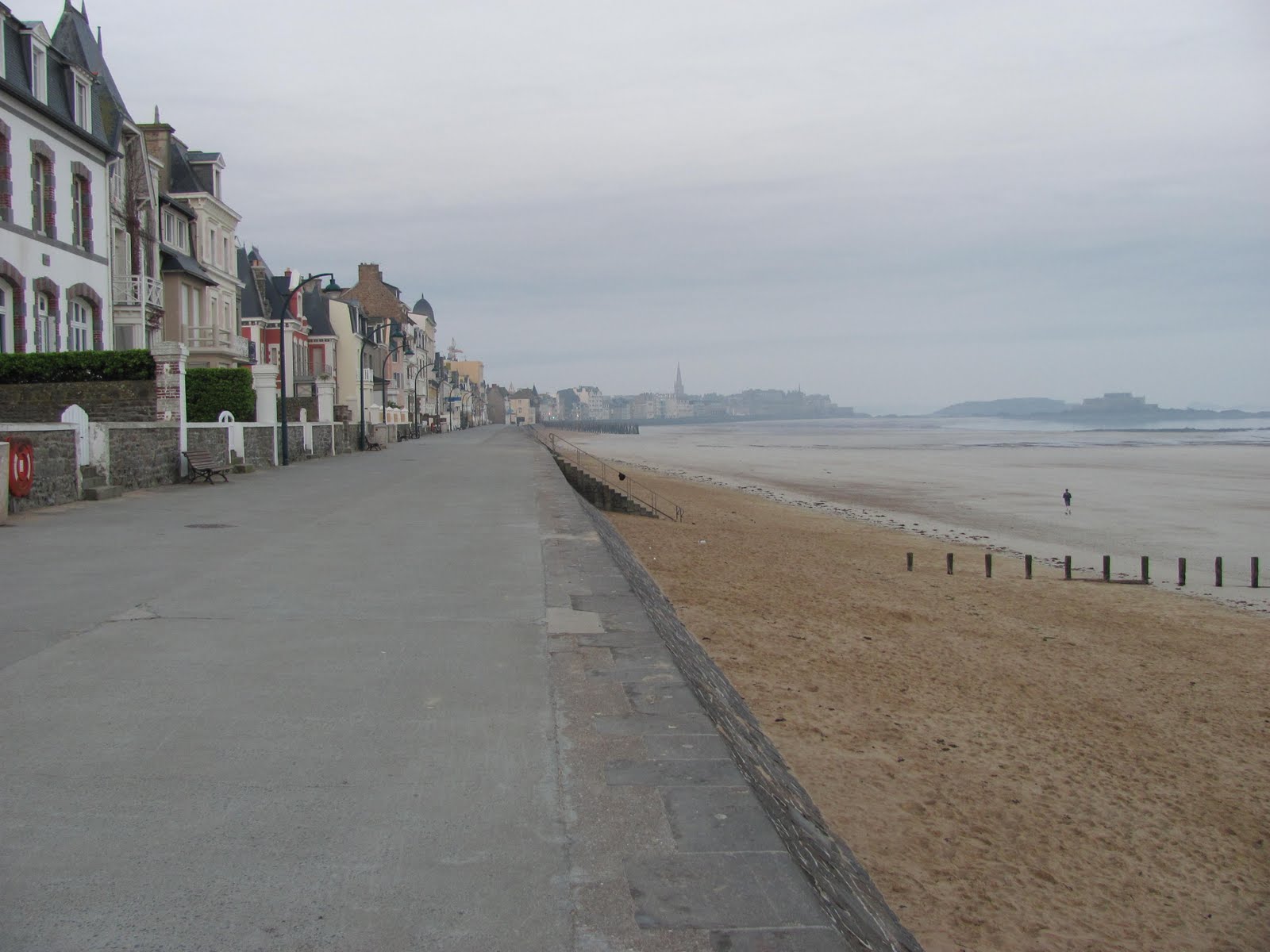
My British-born dentist told me that each year his father, a schoolteacher, would bring 25 boys over to St. Malo to climb on the walls and run along the walkway (and do other less-legal things that lightly-chaperoned teenagers still do).

All along the Emerald coast of Normandy and Brittany are walled towns. Remember Henry V? Henry’s chief accomplishment was conquering the town of Honfleur while hugely outnumbered by the French. The battle made a great film and play, and includes the memorable quote, “Once more into the breach!”

These days, Honfleur, east of St. Malo, is a beach resort popular with both the French and the British.

During the Second World War, the Allies suspected that many German occupying troops were in St. Malo and decided to burn it down. The Germans had barred the gates of the city to keep the Allies out and the citizens inside. Read http://www.ihr.org/jhr/v02/v02p301_Beck.html for details.

The city burned; the buildings collapsed; many ordinary people died, trapped in the rubble.

But after the War, the city was rebuilt. Using the same old building blocks, the ones that hadn’t been destroyed in the fire, and going by photographs, old drawings and maps, it rose again, looking very much like the city that had been there since the 14th Century at least.

Tourists flock year round to see the shops, the narrow streets, the walls, and eat the food.

Not just the Intra Mures [Inside the Walls] part of St. Malo was leveled, but most of the unique outlying homes were, also. And the spirit of the people rebuilt them. Often the workers were women, the men having been killed in the fighting.

People often comment to me that they’ve heard that the French don’t like Americans, that they are rude to us.

I found just the opposite to be true. The French have not forgotten the help Americans gave in liberating their country twice. They remember Lafayette and the role France played in liberating America. A lovely home on a street corner in St. Malo was named Villa Remember (in English).

They love American music. Almost all the music we heard at cafes was modern American, usually sung in English. They love American tee shirts. They love our movie stars. Thank goodness, that with all that love of us, they manage to keep their own identity safe and sound.

Walls cannot compete with curiosity. No architectural wall has ever succeeded, and no artificial wall will long keep people from wondering about each other.

The “something” that doesn’t love a wall is this spirit in people. Once we have seen what’s beyond the wall, the wall’s demise is inevitable.

Friday, May 27, 2011

The Boy in the Blue Hat


Our last five days in France, we were back in Paris, this time in the Montparnasse district.

A couple of days before leaving California, I had learned that the hotel I had reserved on the right bank was in a redlight district. Panicking, I opted for more expensive and left bank Montparnasse, figuring that after 4.5 weeks we might want a bit less of La Boheme. It was a lot more expensive, but hotels were filling fast so I grabbed the cheapest room at the Villa Luxembourg while I could.

Montparnasse: The name stems from the nickname “Mount Parnassus" (in Greek mythology, home to the nine Greek goddesses – the Muses – of the arts and sciences) given to the hilly neighbourhood in the 17th century by students who came there to recite poetry [from Wikipedia].

Wait! I’m off track! I want to tell you about the Boy in the Blue Hat!

About ¾ mile from our hotel was Le Jardin du Luxembourg (gardens, playgrounds, palace, etc.). Every morning while Mary finished sleeping and making up, I would amble over there for an hour or more of blissful reflection. Up Blvd. Montparnasse I strolled, turning left on the street by the fountain at the Place Observatoire, going alongside the long narrow parks where children play and dogs are forbidden, past the College of Pharmacy, and finally entering the garden through the tall ornate metal gates. I wandered in a timeless world where tree-shaded, chair-lined, wide paths criss-crossed the immense palace grounds. It would be early enough for most Parisians to still be abed, having been up late the night before, so only gardeners and joggers joined me there. After meandering along various paths for awhile, I would usually end up at the area dominated by two sculptures, one of a deer family with buck rising majestically over doe and fawns, and the other of a male lion majestically rising over his kill, an ostrich. Every day I thought, “How odd. An ostrich.”

One morning I sat longer than usual, eventually closing my eyes so I could hear the songs of the birds more clearly. I probably dozed as the morning sunrise warmed the air, because I remember becoming aware of whistling in the distance. The tune was gay, like something from the romantic 19th Century rather than our own prosaic one. Curious, but also reluctant to be disappointed, I slowly opened my eyes to search for the whistler.

Across the grass, farther than the next path, and just beyond the border of green trees, danced a young boy in a blue cap, twirling, leaping, pirouetting, flying in and out of the long morning shadows – while his unseen companion whistled and another contributed marvelous tinkling bubbly laughter that filled the air with bright sparkling light.

Watch them and don’t breathe!

I tried to imprint them on my eyes, in my ears, so as to have them forever in my heart.

Try to hold onto them a moment longer while I tell you another story about Luxembourg. When I got home, I was rushing through an online catalog of Impressionistic paintings from around 1900-1910. Suddenly my eyes stopped to stare at a singular one. When my brain detoured back to it, I saw my chair in the Luxembourg Gardens right where the Lion rises over the Ostrich! Someone was sitting in my chair, a lady from another century clothed in black, but otherwise the scene was exactly as it was for me in the mornings of my last five days in Paris.

Was there a Boy in a Blue Cap in the painting, just beyond the row of trees? I hope so. I hope boys will always feel free enough and happy enough to dance through the gardens, laughing and whistling while the world swirls around them.

[Unfortunately, hours of searching for that image to share with you have produced nothing. The best I could do was the one of the deer where the trees are still leafless - news-e.hoosta.com - not full of green like they were that early week in May.]

I know I promised more of St. Malo for this blog, but the boy in the blue hat wanted to be remembered. Next time, back to St. Malo!