Showing posts with label Albi. Show all posts

Tuesday, June 14, 2011

Getting to Barcares via Carcassonne


The little map shows the train times from when we left Albi until we finally arrived in Barcares (Ile des Pecheurs) where we stayed a week in Mary’s timeshare condo.

The bigger train stations, like Toulouse, all have places to buy food, which is handy when you're left too early to eat. For breakfast in Toulouse, Mary bought a bagel with egg, cheese and bacon, while I had a 3-cheese pizza. Another time I’ll tell you about the wonderful ways the French have tweaked traditional pizza.

Our ultimate goal was Barcares (pron. BAR-car-ess), a small town on the Mediterranean. No trains go there, and no-one we talked to had ever heard of it including the usually-helpful folk at the ticket-places in the train stations.

“We’ll just hitchhike if we have to,” we decided.

Meanwhile, we had planned a short stop in Carcassonne, a picturesque and still-living medieval city which we visited in 1961 on our motorscooter.

The Carcassonne train station was dumpy. I needed to use the bathroom so followed the WC signs to an outside coin-operated one. It was standing by itself in a field of weeds, but seemed functional. It cost a Euro, I think, or close to $1.50. I put in my money and stepped inside, not fully closing the door so that Mary could use it after me for free. (Not graft, because inside the train stations the WC is usually 50 cents and as clean and bright as your living room.)

I prepared myself and then sat down. Almost as soon as I did, jets of water spewed forth from invisible spigots in the floor and on the walls! Somehow the cleaning cycle was malfunctioning! Luckily my “business” was finished quickly because I hoisted up my pants, not stopping to zip them, and raced to the door, all the time being pelted with water.

After the flood stopped, Mary tried her luck. We figured the WC cycle was all right now so let the door close. For a minute, indeed, there were no cries of alarm. Then the toilet flushed and Mary yelled that the lights had gone out and she couldn’t find the door! Fumbling around in the dark, she finally felt it. “There’s a button on the left side to push to unlock it,” I told her. “But I can’t see it!” she cried, sounding desperate, and why not? No telling when the cleaning cycle would start again. After pushing all the several buttons she could find, the right one finally clicked and she escaped, as discombobulated by the experience as I had been with mine.

That was the last time we ever used one of those WCs.

We needed to find a bus to the old town. There seemed to be a stop about a block away near what looked like the town square. Sure enough, but which bus to take? About six older women (as old as we are?) were there, so I asked for help. Immediately they eagerly became our tour guides, telling us that we wanted the “Vielle Ville,” meaning the old city, and making sure we got on the right bus because even this small town had many choices. It’s wonderful to be needy like we were and to see the great smiles that come to people’s faces when they’ve been able to help. We bring joy in our stupidity.
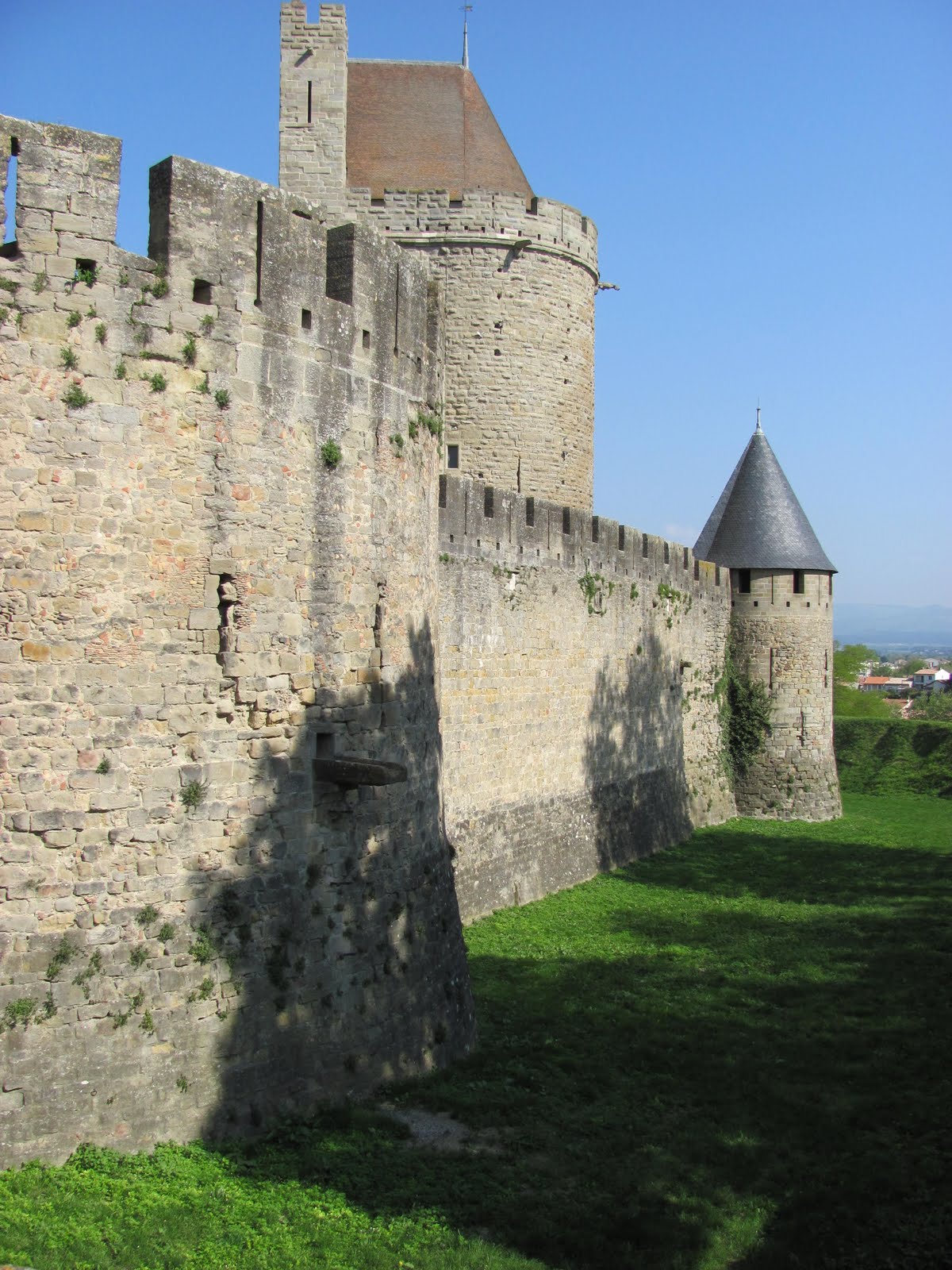
The old city was a huge disappointment. It looks good, but is totally given over to tourists who stuffed the streets looking in all the souvenir shops and buying junk. The crowds, the heat, the tackiness of it got to us and we left after only 20 minutes. That’s a record. I took a picture, though, to prove we were there and not just making this up.

By comparison, here’s how it felt in 1961, riding there from Spain on our motorscooter.

Coming down the slope of a hill, I glanced to my left and there it was, on a small hill above the modern town, practically in my lap! The walls are tall, straight and strong, and it was so wonderful to see them with towers gently illuminated by spotlights from below and a full moon above. It was a perfect, absolutely perfect sight, silhouetted against the starry sky.

I was amazed that we could drive up to and through the old city gates, up a winding narrow road, right to the hostel which is in the middle of the ancient city! We certainly hadn't expected to actually stay in the old city instead of down in the modern town.

After checking in, we went walking by moonlight. I went through an iron gate into a courtyard by the wall just around the corner from the hostel, and came into a different world. I wish I could draw the feeling I got from looking across the massive towers up to the stars and moon. It was the magic of an empty stage after the performance when everyone has gone and in your imagination anything can happen.

The walls are overpoweringly tall. They make you sit and stare, wondering and wondering why and how the craftsmen did it. Wonder what invaders thought, confronted by this massive structure protecting the city within.

It was a thrill to compare with April in Paris, seeing our Capitol, London Tower, Mont St. Michel, Boulder Dam at night, and New York, and just below the amazement of the first glimpse of the Statue of Liberty and Mont Blanc.

At least I have that memory. Maybe it’s still that romantic in the middle of winter without tourists around. Whatever, we didn’t waste time murmuring about it, but hopped back on the train, hoping to get to Barcares before the end of the day.

In the next blog, you’ll see how it went.

Friday, June 10, 2011

Amazing Albi, Part 2

Bertrand showed us to our room, called the Fleur de Lys (see picture from his brochure here, and the photo from our window in the last blog). Wow!

After giving us free entry to the Toulouse Lautrec museum, and agreeing that we needed to see the inside of the cathedral in the afternoon, he told us to meet him back at the Tour at 12:00 and he would show us where to have lunch.

Toulouse Lautrec comes off looking really good in his museum set in the old Archbishop’s palace. Who wouldn’t? His family donated all the work left in his studio to the city, and they have done it proud. All the famous posters are there, including pre-sketches, along with some wonderful seldom-seen works. Since I’d lost my free pass somewhere on the street, they let me in for half price, amid a plethora of apologies. What does plethora mean? Ah, I was right. Thanks, google. An overabundance.

Outside, there was a plethora of tulips in all colors, it being a perfect spring day (see photo).

Then Bertrand walked us to the restaurant. It’s good we arrived early because by 12:30 the place was packed. And no wonder. The food is excellent. Our choices had been decided by Bertrand and the waitress, Rosille – then he left.

The salad was tiny spinach leaves and sesame seeds over chevre (goat cheese) and a pate of mixed veggies including eggplant, very light and smooth, on tomatoes, on crumbled shortbread cookies sprinkled with balsamic and oil. The main dish was savory slices of turkey with perfect vegetables and penne pasta. A+. Rosille said that dessert was “rice cooked in milk.” The reality was rice cooked in very creamy milk with a banana/apricot sauce flavored with lemon and ginger, sprinkled with chopped pistachios, and topped by a delicate flower of whipped cream. Not like any rice pudding I ever made!

Each dish was eaten very slowly to savor every tiny bite, not my usual “chow down or it will go away” style.

We left, fully satisfied and ready to take on the cathedral.

As powerful as the outside is, the inside is equally amazing. Paintings done in the 1500s have not lost their luster. The trompe l’oeuile is baffling [see photo]. The statues, big and little, have personalities. Go. See for yourself.

Just inside the entrance was a notice to all visitors that touched me deeply. Here it is, first in French because it’s so beautiful in the original language, then I’ll translate:

“En admirant la beaute du travail des hommes, puissiez-vous trouver la presence de Dieu. Que cette visite rest en vous comme un moment de Paix. »

English : In admiring the beauty of the work of men, you might find the presence of God. May this visit remain in you as a moment of Peace.

It is the most beautiful way of describing why great artists through the centuries have welcomed the chance to work on these buildings. Their love of God inspired them to heights they could not have achieved on their own. And now we, living in a crowded, tempestuous world, see their work and feel a moment of peace.

After exploring the town some more, it was time for dinner. Bertrand showed us to another specially-chosen restaurant where we were treated, thanks to him, like honored guests. More elegant than the lunchtime place, the food was excellent but not quite so excellent as that other. However, the dessert, oh my. Fondant (I’m not sure what flavor that was) glace (ice cream) with a thick perfect raspberry sauce.

It was quite late when we arrived back at the hotel, but Bertrand was waiting for us. We explained that our train left very very early in the morning, 6:00, I think. We would have to rise even earlier, probably 4:45 (because of Mary and makeup) to walk there in time.

He wouldn’t hear of it. No. He himself would drive us in his Peugeot to the station. We protested, but he insisted. So before the sunrise, he was at the gate with his little car, perfect for the narrow streets of French towns. He took our packs, loaded them in the back, and off we went, me in the back seat and Mary in front.

I am not imagining this – he had been flirting with Mary all this time. She denies it, but I am sure of it. She’s a widow of only a few years, so may not recognize the signs yet. I found it charming of him.

At the station, he carried both packs into the waiting room, then stayed with us until the train pulled in. He then carried the packs onto the train, which was crowded even at that hour, and gave each of us the little French kisses.

Waving to us from the platform, we waved back, knowing we would never forget Albi and Bertrand.

Amazing Albi


Albi is an hour by train from Toulouse. Three stars from Frommer’s France means it’s one of the best. I went online and found a hotel with good reviews, less expensive than the others in town, and booked one night. How could I know that La Tour Sainte Cecile would turn out to be our most exceptional stay in all the five weeks?

Let me explain --

We arrived about eight in the morning and found ourselves at a small deserted train station on the outskirts of town. Near the street was a large framed map of Albi, so we studied it, trying to figure out where we were and where we were going. There was no “Vous Etes Ici” mark to get us started. After about five minutes of confusion, a middle-aged woman ambled across the street to us and said, in French, “Don’t look at the map. It will get you lost.” She then pointed us in the direction we should go, saying, “Keep to the right, go across the bridge, always to the right. When you get to the cathedral, ask anyone for directions.”

Hoisting our backpacks, we started walking, not knowing how far we might have to go. We went down a hill and came to a cross street where turning to the left seemed to be the better-traveled way. While we stood there pondering, up trotted the woman again to help us out. She’d been watching us, caring about us! She is one huge reason why we loved Albi. Another is Bertrand, but that comes later.

Even though the walk wasn’t easy (the backpacks seemed heavier and heavier), it was along a lovely flower-bedecked and tree-shaded street that passed a school where children were just arriving. The small bridge didn’t span water, just a chasm, and then we were trudging uphill into the town which was still hidden by curves in the road and trees.

Rounding a corner, I stopped in amazement! At the top of the street was an overwhelming sight – the Cathedral of Sainte Cecile. Look at the picture! The largest all-brick building in the whole world, it has a commanding presence that simply knocked me for a loop! Right there in the little town of Albi!

Built in the 13th Century, it is – once again, overwhelming. I must quote from the booklet I bought there (the only one I bought during the whole trip). Oh, never mind. You weren’t there so it might be boring to try to imagine it. Go there! You’ll love it!

We didn’t stop to go inside since we still had the backpacks, but instead went in search of our hotel. The street was easy, Rue Sainte Cecile, right off the main square by the Cathedral. The number presented a problem, though. We found 8, 10, 12 and 16, but no 14. Dismayed, even wondering if I’d been duped, I went to the hairdresser shop across the way and asked if anyone knew where No. 14 was.

Laughing, the owner set down his tools and walked us across the street to the ornate wrought-iron gate and pointed down a narrow private walkway between Nos. 12 and 16 to a heavy old wooden door.

Amazed, I asked, “Vraiment?” “Oui. 14.”

I worried that we were arriving too early, since it was only 9:00 and arrival time should have been around 11. The door was locked, but there was one of those communication thingies so I pushed a button and heard a phone ringing inside. A man answered and I apologized for being too early.

“No problem,” said he, sounding delighted that we were there. We heard the lock on the door open, then climbed up two narrow flights of stairs (later finding the elevator) to meet Bertrand, the charming host of La Tour Sainte Cecile.

It’s not a hotel, but a “Chambre d’Hote,” which I gather means that a private person is opening his home to visitors. What a delight for these two scruffy, inelegant women to be lodged in the 13th Century home that Bertrand grew up in.

He and his two sisters inherited the family home when his father died, and partitioned it into three separate areas. Rather than keep his section to himself, Bertrand decided to share it with visitors so he could meet people from all over the world. He loves people of all kinds -- and I tell you, he’s adorable. When you meet him, you’ll see I haven’t exaggerated or used the wrong word.

The next blog will go into more detail. Don’t miss it! Our one day in Albi was a day of fairytale enchantment (but not at all like Disneyland).

The photos are my first view of the cathedral, Mary and I in Bertrand's living room, and the view out the window of our spacious room.

Monday, June 6, 2011

Bacchus and Me


I don’t drink wine, so I was delighted to discover that water with meals is perfectly acceptable now in France. Back in 1961, tap water was suspect, but now it’s perfectly safe. If you want to pay a premium for it, you can get bottled water, even bubbly bottled water, but the best way to order ordinary water is by the carafe.

A carafe is a lovely frosty bottle that once held wine. It is brought to your table along with two small wine glasses and replaced as often as you like. It seemed to me that this was a classy way to serve water. A step above putting a plastic glass of water and a straw in front of you.

I got in trouble the first time I tried to order a carafe in Paris. Not knowing the right word, I ordered the wrong kind of water. The waiter pointed to a nearby table where a bottle of water stood and I nodded because it looked like what I’d seen elsewhere. He brought a bottle of Evian water, expensive.

“No,” I said. “But this is what you ordered,” he rejoined testily. We may or may not have been speaking in French. “But it’s not what I want,” I pleaded. “It’s what you asked for,” he scowled. “Non, s’il vous plait. Not in that bottle.” Furious, he grabbed the Evian off the table and stalked off to the kitchen or wherever and after awhile brought back a “carafe,” plunking it down on the table with such force I thought it might break.

After that, I didn’t exist. Mary was the only customer at our table. Later as we were leaving, I complained to her about how rude he’d been and she said it was my imagination. Not! I’ve been ignored before and recognize the signs. It’s hard not to.

I think this was probably the only actively impolite French person we met. However, look out during tourist season! He was only warming up with me. Remember: “Un carafe de l’eau, s’il vous plait.” Un carafe. Don’t forget. Unless you’d rather have wine, which is fine, of course. Mary frequently had some wine. I’m the teetotaler, not her.

After I got home, I had a regular appointment to check my blood levels – cholesterol and all that stuff. I was curious if all the cheese I consumed daily might have affected things. It was not a lowfat diet by any stretch of the imagination.

Curious, I looked up the prevalence of heart disease in French women, both because of their cheese-rich diet and the huge number of female smokers. It turned out that recent studies have shown an increase in heart disease that’s attributed to smoking rather than diet.

The reason the fat-filled diet didn’t raise cholesterol levels was suggested to be the drinking of red wine with meals.

Help! I come from a long line of alcoholics and do NOT want to drink wine (also, I am a Latter-day Saint and we don’t drink alcohol). I do drink grape juice, however, so I looked up (yay google) to see how it compares to wine in fighting heart problems. What joy to find that it’s just the same!

All the good things in wine are also present in the juice before fermentation.

Whew! However, the day my blood was drawn for the test, I was still on my French diet – pastry, cheeses and no grape juice. I had lost two pounds but my bad cholesterol was up about thirty points. Ouch.

I’m sure that if you’re concerned about diets the way most of us are, you know that a few non-doctors say that animal fats are good for you, even better than vegetable fats. Don’t believe it! It may be marginally true for a few people, but my daughter-in-law and I have seen the results of eating a lot of animal fat (butter, for her; cheese for me) and for each of us, our bad cholesterol rose. When she went back to a vegetable spread instead of butter, her levels went back down.

I will still eat cheese, but more moderately than before. Paul Newman’s Own Concord Grape Juice sold at Costco is the best I’ve ever tasted. Who needs wine when they can have that!

Actually, I don’t know if you can order grape juice in France. In the late afternoons, when we would stop at an outdoor café for a rest/snack, I would order hot milk (it comes whipped with sugar on the side), which is as good as their cheese. I believe the cows and goats grazing on the lush green fields of France are superbly happy because the products made from their milk are unmatchable.

If you are in France in August, the French who are left in the cities might well be grumpy. All their friends are off at the beaches or the mountains, and they are left behind. Try to overlook their scowls. Order your “carafe de l’eau” and thank the waiter for your delicious meal. Even a hard French heart will melt if treated kindly.

[The photos are Mary and the waiter in a gem of a tiny restaurant down a narrow street in Lyon; a patisserie in Albi showing that we weren’t the only people in love with French pastries; a café in Collioure on the Mediterranean; and Place Stanislas in Nancy, filled with places to sit, drink, and watch the world go by.]