Sunday, August 7, 2011

Dumbfounded in Tours

You’re forgiven if you thought this blog was going to be about tours we took. It’s actually about Tours, France. Even the computer got it wrong! I tried several times on Hostels.com to book a room in Tours, but every time, I got “Tours of France” instead of Tours, France. Finally, I went to another site, Bookings.com, and got a great room at the Mirabeau -- in Tours.

Be careful what you name your towns! Like Worms in Germany. I know it doesn’t mean the same in German as English, but still . . .

I skipped Tours on the blog so we could hurry to Albi and the Mediterranean, but now I’ll take you back to Tours, Amboise, and Toulouse, all great stops. These were in April, right after St. Malo on the English Channel, if you remember back that far.

It was a long train ride from St. Malo, but I almost made it shorter by getting off at the wrong station! It was kind of obvious that the little town wasn’t the major city of the Loire Valley. Luckily, Mary asked someone and sure enough we had to run (as in run) up stairs with our backpacks to re-board the train before it left for the next stop, the right one.

It must have been my day for messing up because when I went into what looked like a tourist office and showed the lady inside, the address of the Mirabeau on Blvd Heurteloup, she had no clue but pointed us down a pedestrian walkway to where the major bus lines were. A few blocks later, hot and tired, we reached Rue Charles Gille and, sure enough, buses. The google map I’d printed out seemed to say the hotel was near the river, so we decided to walk since on google it didn’t look that far.

Reached the river and didn’t know which way, left or right. Asked again. Directed to the right. Started walking. April 2011 was a record for heat. Most days that was great, but not when carrying the backpacks and not knowing where we were going. Walked and walked. Decided to catch a bus. Found a stop and got on, hoping it would get us somewhere closer to the hotel. At least we got to sit down. To shorten this story, after over an hour of much walking and much getting lost, we found the Mirabeau. It’s in plain sight on a major road with a pedestrian tree-shaded walkway down the middle.

The lady in charge was puzzled when we asked if we could possibly get a taxi back to the train station on Wednesday morning, two days away.

“But it’s only three or four blocks away,” she said, showing us her location on the map, and the train station.

We were dumbfounded! We’d walked and bused all around town to get there, and we could have easily covered the distance in ten minutes! Not only that, but the tourist lady’s office had been practically right on Blvd Heurteloup and she didn’t know it!

The Mirabeau was superb! Our room faced the street, with a balcony. Two double beds, bath with a shower, sink, and toilet. We hadn’t minded sharing a bed, or the trips down the hall to the WC in the other places, but this was blissful luxury for us.

Mary was miffed that there was no soap, even though we each had brought our own. “It’s a little thing; drop it,” I said, but she went to complain.

In doing so, she had a nice chat with the lady in charge, who showed her the beautiful breakfast room and talked about the history of the place, how the entry used to be the place where horse carriages entered the courtyard. Now it's the patio off the breakfast room, and the stables are in the next property over

Mary brought back soap, and we signed up for the bounteous, leisurely Petit Dejeuner (breakfast).

This was April 11, an auspicious day because in Vancouver, BC, my newest granddaughter was slated to be delivered by Caesarean to daughter Alisa. Here I was, nine hours ahead of them and half a world away, trying to get in touch with anyone who could tell me what was going on. I called daughter Celia three times and husband Thrim once, with no answers, then finally found daughter Mieke in New Jersey who said Alisa wasn’t going in until 1:00 p.m. Vancouver time. I would have to be patient.

Sahana was born healthily and happily, and Mom, Dad and baby and sister were doing just fine. What a relief! Also Indian grandmother Lakshmil who had come all that way to help out for two months!

In Tours, Mary still hadn’t completely recovered from the mystery malady that hit her in St. Malo. However, we were desperately hungry, so we trekked into the old town, which was very close to us, past a marvelous cathedral, St. Bastien. The high old walls bordering the street – see the photos.

All through this area were narrow winding streets and architecture with wood and wattle or brick patterns like you see in old England. We ate on Rue de la Monnaie (Money Street). It was a darkish place that wanted more “monnaie” than it was worth, but the green beans were tasty. Usually there weren’t a lot of vegetables with the meals unless you ordered a salad. I missed veggies.

Tours is in a great location for chateau-viewing, and one of the best and closest is the Chateau d’Amboise. The next day we took a regional bus there, getting tickets at the same place where the woman steered us astray.

Since Mary needed rest, she took a nap at the hotel for the 90 minutes before the bus left, and I went exploring. The old town is full of schools from preschool to high school and even college. I hurried to the cathedral, got some pix, then wandered around and ended in the Jardin Mirabeau to the sounds of joyful children at recess. Happy, obedient children, who are noisy at play, but so quiet at other times you hardly know they are there at all.

Tours is well worth a stop, should you be in the Loire Valley chateau country. Just don’t ask directions at the place that looks like a tourist office outside the train station but is actually the regional bus ticket place. They don’t know Tours. The real Office du Tourisme is half a block north on the other side of Rue Heurteloup.

Wednesday, August 3, 2011

Perpignan and the Good Life


Perpignan, with street signs in French and Catalan, was a lot more interesting than I’d thought it would be. We’d seen it from the bus window for two days, and the crowded, narrow streets seemed uninviting. However, with nowhere better to go on Friday, I chose Perpignan – and Mary said OK.

Walking a city is always better than riding. However, at first, it was daunting. We needed to get to the Office du Tourisme, pick up a map of the city and talk with someone who knew the best places to go. For some reason we were both tired and grumpy, blaming the gods for putting the tourist office so far out of our way.

Actually, it was in a good location if you had gotten off the bus a few stops earlier.

Each time we reached a corner where it should be, another sign directed us farther on. Farther. Farther still, until we were ready to give up. That’s when it finally appeared across the street, part of a huge building, kind of a cultural center with a big park alongside, and an Indian movie festival inside.

We got our maps and info, checked out the Indian display, then strolled through the adjoining park, found a bench by a fountain where a lovelorn poet played a plaintive guitar while a scary animal chased a naked lady. Our lunch of goat cheese and terrine sandwiches and fruit set us up for a splendid afternoon of exploring the old town.

Perpignan is a mixture of Catalania, or southern Spain, and France. Many signs are in both languages; in fact, it’s probably more closely related to Barcelona than Paris.

We climbed up steep marble-like steps to the Place Moliere and thence to the “Routiere” or old Armory where there was a photo exhibit by Jacques Fulcara. It was cool inside; pix were good. I especially liked the texture and how he found patterns in small details. Then on to the Chapel of Tiers and an art exhibit with beautiful colors and scenes of local places and people.

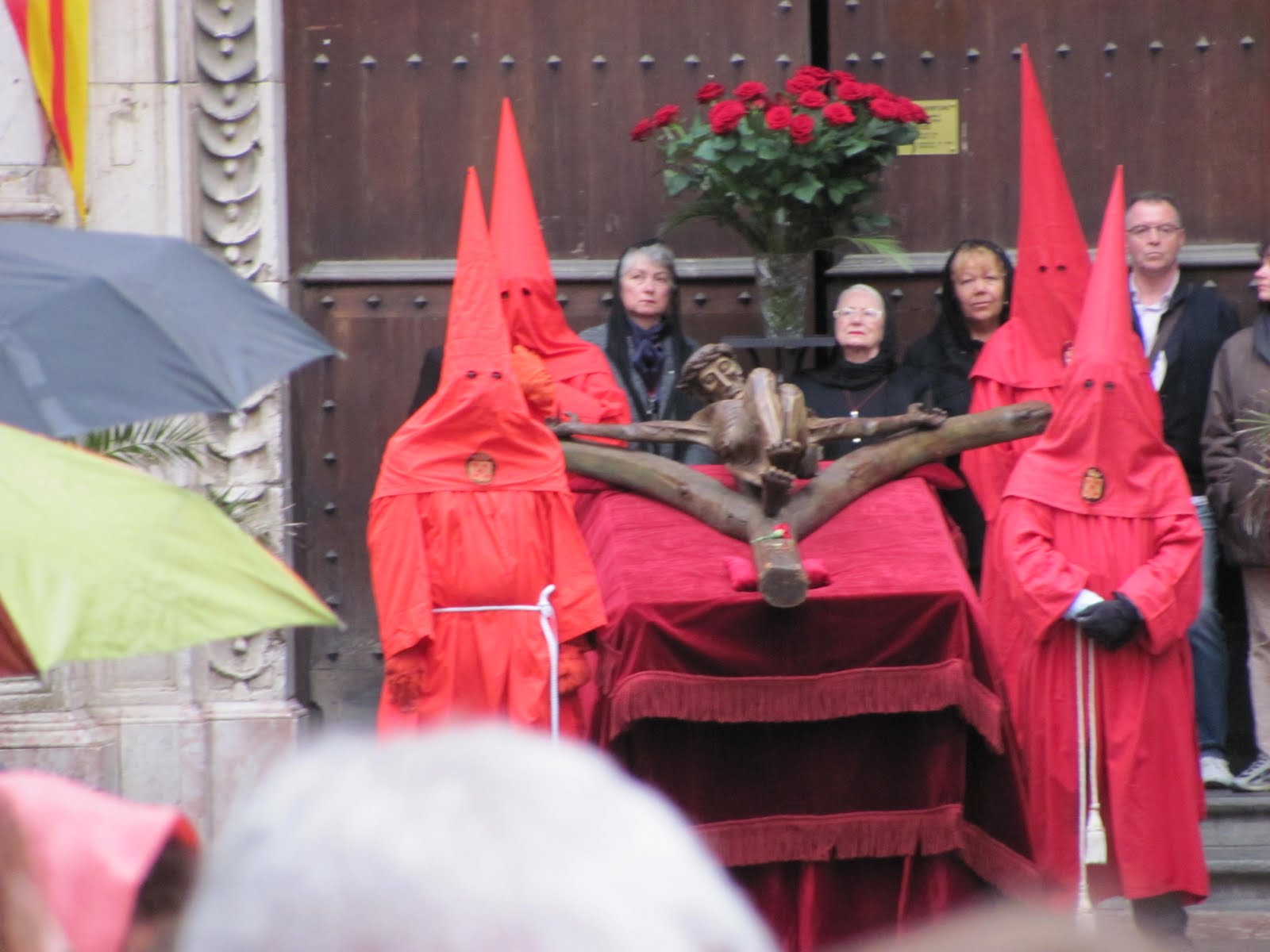
Mary asked about the significance of the men in tall red Ku Klux Klan-looking outfits that had also turned up in the photo exhibit. The guide went out of her way to explain “la Shant,” but I still don’t really understand. It’s a local word for the procession that winds through town the Friday before Easter, which this day was.

The procession celebrates Jesus’ ascension. The people in the red hats are anonymous (but well-known locals) and carry the statues to various stops where more and more people join in – women, children, men. Prayers are said over loudspeakers for the people of the region asking forgiveness. On Saturday, all the fountains in town will be filled with red roses, symbols of Mary, and undoubtedly beautiful.

The procession would begin in about an hour and a half! I admit I’d been doubtful about Mary asking about the red costumes – what if they’d turned out to be a KKK-type organization ready to burn heretics or whatevers? – but if she hadn’t asked, we wouldn’t have known about the procession and all the rest.

Lucky for us that Mary’s curiosity often overruled my shyness. [Insert heavy sigh.] Because I wouldn't ask the difficult questions, she stumbled along in charming charades mixed with a few words in French and some in English. She usually got good results on her own, since people were willing to try really hard to know what she was saying. If I could tell the point wasn't getting across, I would chime in to explain. That way I couldn't be embarrassed because it was clearly Mary's question, not mine. I, of course, benefited from the answers just as much as she did.

We found a perfect spot by the cathedral and gendarmes, and watched the crowd gather. After awhile, the clouds gathered, also, and it began to rain. Heavily. Umbrellas came out, but people didn’t move, except us since we’d left our rain gear at the timeshare. We backed up against a building with a slight overhang and waited.

Look at the picture of the two ladies walking toward us. Aren’t they wonderful in their colorful, oddly mixed clothes? Independent and marvelous sense of fashion! And the colorful umbrellas! No wonder so many artists love the south of France!

Because we weren’t prepared for rain, we got cold waiting for the procession to move. The red hats stood outside the cathedral entrance and nothing else happened, so after awhile we went to find shelter in a nearby restaurant. Warm and dry inside, Mary ordered hot chocolate and I got hot milk. All of a sudden, everyone in there moved to the big window to the north, so we did, too. It was the procession coming right by the restaurant!

In the rain, the statues covered in plastic for protection, the people wound their way through the streets, prayers being spoken through a public address system. It was quite lovely, especially seeing the children following along in their best clothes. Sorry I don’t have a picture of them.

After that, we caught the bus back to Ile des Pecheurs and packed up for travel to Nimes the next day.

It rained all night. By morning, the rain had stopped but we were flooded in. I waded barefoot to the little store across the way, bought some waterproof sandals, and asked at the office if we could be “airlifted” out when checkout came. They agreed, I waded back, and at the appointed time, a man with a golf card and a long board (read “gangplank”) showed up.

This week on the Mediterranean turned out to be far nicer than we had expected. On the map, it looked as if nothing much was there. Thank goodness it was April, because in summer I hear it’s wall-to-wall people. Well, sure, why not? Good climate, incredible scenery, great food, interesting history, nice people. What more is there to the good life?

Monday, July 18, 2011

The Bus That Was a Train


The trip to Cerberes was so memorable that I’m going to skip Tuesday and get us to Wednesday when we again took the ONE Euro bus down the coast, getting off at the town before Cerberes, the very popular Coulioure.

When we passed by it on Monday and I saw the castle guarding the bay, and most of the passengers getting off there, I worried that we had made the wrong choice by going on to Cerberes. Nope. It was worth it. And anyway, on Wednesday we got our chance at the town with the castle.

On the way there, a nineteen-year-old boy from Germany boarded the bus, a hitchhiker. He sat right behind us with his backpack, and the couple behind him, Brits, started a conversation with him. His adventures sounded a lot like Mary’s and mine way back when, so finally I turned around and introduced us, explaining that 50 years ago we, too, had been hitchhiking all over France.

“Really?” He was amazed (his English was good), and I smiled, realizing that he saw us as two fairly old ladies, not two young girls.

I told him about my nephew in Germany whose mother, my sister, won’t let him hitchhike even though he, too, is nineteen.

He laughed and said his mother didn’t want him to, either. He has to call her twice a day!

The same winding road dropped Mary and me on a corner above the bay at about 12:30. Then we walked around the beautiful Mediterranean port with colors on colors on the buildings. A lot more tourists were here, making it more crowded, but the ice cream was good and the scenery superb.

Actually, though the ice cream was fine, the girl serving up the cones needed a course in customer relations, especially before summer arrives with even more tourists. We met so few crabby people that it was always a surprise when we did.

Another thing we didn’t meet in spite of dire warnings in all travel articles: Bed bugs. None, though we stayed in some really cheap places and also some pretty classy ones.

And another thing: Thieves, especially gypsy children lying in wait to slash open our backpacks when we weren’t looking. None. Only nice people.

I know you’ll enjoy the pictures - shops, castle, boats, view from the queen's room, me eating an apple which I did a lot since they were so full of flavor.

Historically, Coulioure was a major port, exporting (like Cerberes) honey, wine, fruit, cheese, and a variety of other things. Kind of makes your mouth water, doesn’t it? Its products were so plentiful, and the location so exquisite, that it changed hands a jillion times over the centuries. Romans had it, then Spain, then the Mallorca part of France (when Mallorca was a part of France), and finally in the 1700s, France got it permanently.

In the 1400s, gunpowder and heavier artillery made it imperative to fortify the castle more strongly. This story of war changing lives and nations was repeated so often wherever we went, that I would look around at the peaceful countryside where, now, everyone co-exists without throwing stones or grenades, and wish the head honchos would get a clue. Peace can be more lucrative than war.

The picture of the port from on high was taken from the queen’s rooms in the castle. I’m sure she loved sitting by the window embroidering or whatever, looking out at the water and ships. Did the ladies (or even the men) ever get hot enough to go swimming? I don’t know, but if I lived then, I surely would have gone in the water, and not with pounds and pounds of silks on, either. Maybe a cotton chemise.

When it was time to leave town, we asked a shopkeeper how to get to the train station. She pointed the way and seemed willing to go along with us except that she'd have to close up her shop to do so. Another great person.

It was quite a hike uphill, and when we got there, the lady at the desk said that the train was actually a bus.

This was beyond my comprehension. I told Mary what she’d said and it didn’t make any more sense to her. Nonetheless, we bought what certainly looked like train tickets (knowing the one euro bus at 7:00 wouldn’t get us back to Perpignan in time for the bus to Ile des Pecheurs) for about six euros each.

Where to catch it? She circled a corner on the map which turned out to be the same corner where the shopkeeper was. Back we trudged, tired after a long day of being tourists.

An older man (maybe even older than us) at the bus stop almost scolded us, saying that the only bus stopping there was the 7:00 one. We showed him our tickets and he scoffed, saying those were train tickets, which we knew already.

There was nothing to do but ignore him and hope for the best. Fortunately, an Irish couple strolled past and provided a nice interlude of English conversation which we hadn’t had for a long time, well, since the German hitchhiker on the bus, but that wasn't the same thing. They were walking back to their son’s home in the next village. Doesn’t that sound fine? Walking along the Mediterranean coastline to a small village where your son has a home?

More people began to arrive at the stop, and then the bus bearing a “ter” sign (the name of that type of train) came, much to my relief.

Here’s what’s odd: The man who tried to make us go away, also boarded the bus that was a train. The winding, winding trip to Perpignan lulled me to sleep and I forgot all about him – until now.

Dinner that night? I knew you’d want to know. Canned cassoulet (beans and sausage) from the little store at Ile des Pecheurs, bread and goat cheese. Superb.